
Priority Charging
Priority charging and delayed charging is only relevant when there is not enough current to have all chargepoints charge at full speed.
This happens when the configured grid limit is low, energy meter measurands approach the limit, Time of Use is configured or when the grid is part of another grid that has restricted the current flow. The loadbalancer algorithm is built to divide the available current fairly to all vehicles connected to Edge.
How much current is being divided by the priority charging algorithm to a charging session is not only determined by how much current is available divided by the amount of charging sessions, but also by:
- How long is the vehicle charging (longer means lower priority)
- How much power the vehicle has charged (more means lower priority)
- If the station or vehicle is charging normally (resets means lower priority)
If there is not enough power to charge all vehicles at the same time, the station with the lowest priority will be turned off. This is delayed charging. When the vehicle is in delayed charging its priority will rise until it can be turned on again.
This system ensures that vehicles charging longer will get more power, but vehicles that have just arrived will not be in delayed charging. At the end of the day each vehicle should have been given the same amount of current.
Set Priorities Manually
By default, all chargepoint sessions start with the same priority. Currently there are 3 ways to overwrite the priority:
1: Configure a Priority to a Charge-Card or Token
This is explained in the charge cards page.
2: Configure a Static Priority on a Chargepoint
- In the live-view, click on a chargepoint.
- Then go to its settings.
- Open the "Advanced tab". Here the priority can be changed.

3: Adjust the Priority on a Running Charging Session
- In the live-view, click on a chargepoint.
- Then the priority can be adjusted if a charging session is running by clicking on the up/down arrows.
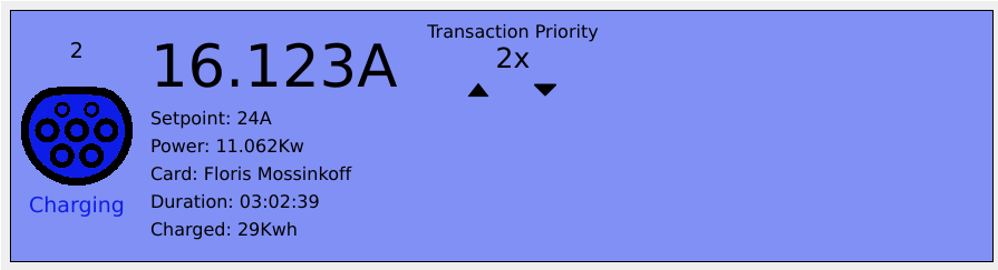
When changing a priority from 100 to 200 this means that the current offered to this vehicle by the priority mechanism is twice as high. This does not ensure that the vehicle will charge at full speed.
Example
If you have a grid with 10 AC chargers with the default 100% priority and 1 DC charger with 1000% priority. And the available power at that time is 80KW.
This means that when all chargers are charging, the DC charger will get 40KW, and the 10 AC chargers will get a combined total of 40KW, meaning that each AC charger charges with 4KW.
Updated 7 months ago